


Moor Battery
Moor Battery
Performance collaboration,
by John Sturgeon & Jörge Haberland ©1992
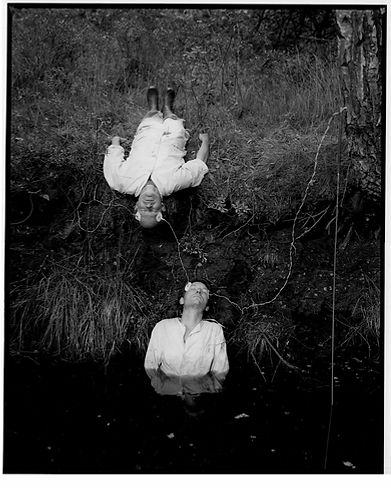
PHOTO CREDIT: © Helmut Kunde 1992
Moor Battery was one of several works Sturgeon executed as part of Symposium Moor 1992, an international festival of performance & site specific work on the Wittemoor. The Wittemoor, Germany is part of a larger complex of moors (bogs) that stretch across northern Germany and The Netherlands. This month-long festival gathered European and American artists, to live on, investigate and then respond to environmental issues evoked by the delicate ecology and unusual geographical-archaeological sites on the Wittemoor.
Moor Battery was a performance collaboration between Sturgeon and German artist Jörge Haberland, using various sites in the Wittemoor - the bohlenweg (an ancient, wooden trestle path), the black bogs and the grassy marsh. Sturgeon & Haberland documented themselves probing the moor with long, 2 meter, stainless steel rods with copper tips driven deep into the moor and then attaching the upper tips to their foreheads with medical EKG sensors. Metaphorically, they analyzed the moor as a source of energy and as a reservoir of memory.
Moor Battery was a response to a seemingly subtle, but striking quality of the moor environment; the physiological and psychological effect that it has on visitors to these locations. At first, a profound energy drain was noted, in some cases even inducing sleep; however, after longer periods on site, this effect was followed by an inversion, an energizing of body and mind producing a prolonged period of mental and physical activity. From these draining/charging observations along with investigations of the unique acid and alkaline chemical base of the moor, it seemed that the composition of moor was something akin to a battery.
As noted from the famous excavations of the bogmen in northern Europe primarily from the twentieth century, the moor is composed of a chemical structure (acidic, oxygen poor), that preserves certain carbon-based elements such as skin and hair, while rapidly decomposes others - bone and flesh. This “tanning” process leaves them remarkably lifelike but without internal structure. It also serves as a tomb for artifacts such as the bohlenwegs as well as for human or animal remains.
Symbolically, Moor Battery highlighted the dynamic of this energy system functioning as a storage environment yet with selective memory - the creating of a consciousness, while dissolving the remainder into unconsciousness.


