


Spine/Time
SPINE
TIME
JOHN STURGEON
©1982
color, 22:00 minutes, stereo
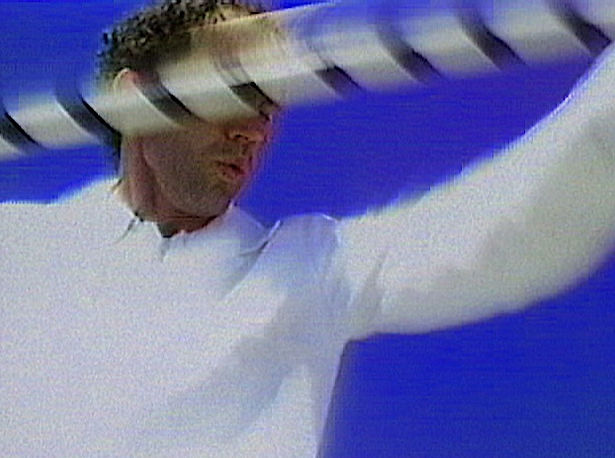
SPINE/TIME is a poetic/dramatic work on the transformative process of being. The video is involved with time and the nature of discovery, in time, as the self does personal archeology as well as future scans at the edges of consciousness - separating, purifying and assembling the essence of the data.
The spine, not the brain, is spiritual key to the integration of experience of the larger Self. We might conceive of the spine as a conduit for travel within the canvas of self and that as one probes and moves within that time/space we begin to approach that which is timeless and universal.
Set locale includes the deserts of Utah and the geyser basin areas of Wyoming. The pixelized camera generated sequences, graphically display the alchemical precept through abstraction, that which is essential is not destroyed.


The artist's communication is direct, speaking from a spiritual source within his inner self. He develops a tension that provokes the viewer, necessitating a personal response.... SPINE/TIME 's formal structure is linked by a chain of events that associate ideas, culminating with an emotional liberation.
Kathy Huffman, Curator, Second Link 1983
In this tape, Sturgeon seems to be representing humankind in search of its history and its meaning. In stylized actions he seeks it in earth and water, in the desert (as Biblical prophets did), and finally finds it in himself.
Anne Edgerton, Curator, Young Talent Awards 1963-1983 (Retrospective), Los Angeles County Museum of Art, 1983
For him (Sturgeon) technical energy is organized in a particular way which is not separate from his own being - there is a mystical union which he does not fear.... He tells us that his individuality is no longer important and - 'As the wheel turns, the knife and kiss are one. And in that moment of embrace, I am wing and air'.
Marie Morgan, The New Narrative, Banff Centre, 1984


Don't you know?
Don't you know?
I know!
I know - I know I'll never know.
Don't you know? Don't you know?


I'd like to talk to you about purification, by abstraction.
When the matrix divides the image into pixel,
that which is essential is not destroyed.
Purification by abstraction,
that which is essential is not destroyed.
Fire destroys that which is inessential.
Purification by fire destroys only that which is inessential.
Purification by abstraction,
that which is essential is not destroyed.
Fire is electricity.
Electricity is matrix.
Matrix is abstraction.
Purification by abstraction,
that which is essential is not destroyed.


I'm doin it... (whew!)
I'm doin it... "
We're doin it... "
we're doin it... "
...1988...
...1989...
...1990...
We're doin it... whew!
I'm doin it... " "
We're doin it... " "


I'm talking to you
from somewhere in the past...
about the future.
I'm talking to you from the future...
about the past.
I'm coming from behind you...
I'm looking ahead of you...
I'm somewhere in the past -
I'll meet you in the future -
I'm part of you in the past -
I'm your future...
In the past, in the distant past
In the distant future -
from the past - to the future...
From the future...
From the past...
From your past -
From our past -
To your future -
To my future -
To our future -
To the absolute future,
from the absolute past,
We are going forward...
...1998...
...1999...
...2000


As my fingernails part the skull hair,
the hand reaches forward and backward centuries.
In the mind’s eye, I die again.
The old battleground gives way to some distant face,
whose lips this thought has yet to move.
No longer a question of self.
No longer a question of humanity,
no longer.
As the wheel spins, the knife and kiss are one
and in that moment of embrace,
I am wing and air.


The Second Link Video Viewpoints in the Eighties
International touring exhibition 1983-1985
Catalogue excerpt from – “Video Art: A Personal Medium”
by curator, Kathy Huffman, Long Beach Museum of Art
John Sturgeon's "SPINE/TIME", represent(s) a future vision, utilizing
advanced technology and special effects to visualize their philosophical message.
These techniques are not only appropriate, but necessary to convince us of the
uncertainties of the coming decade. Sturgeon, as "Shaman" in "SPINE/TIME",
is seeking the future through experiences of the present and the past. This search is
punctuated with probing parables like, "I'm fine in the body"; a statement that reflects
the artist's psychological and physical certainty.
Dialogue is encouraged by confrontation with his invisible viewer. "Don't you know? . . ." and "I'd like to talk to you? . . ." demand participation. The artist's communication is direct, speaking from a spiritual source within his inner self. He develops a tension that provokes the viewer, necessitating a personal response.
By leading and directing a series of quasi-scientific/primitive explorations, Sturgeon
formulates the position that his future is our future; the absolute future. Integrating
spiritual intuition with scientific technique, this videotape creates a contemporary
empirical solution for achieving personal integrity. The artist travels through a
dimension of time and arrives at "that which is essential (is not destroyed) . . ."
This dreamlike process is the artist's private view, and is communicated by a magical manipulation of events and sequences.
"SPINE/TIME's" formal structure is linked by a chain of events that associate ideas, culminating with an emotional liberation. "The formulation of a new consciousness is integral to the artist's role of mapping out society's future", believes Sturgeon, who demonstrates this viewpoint through his presence in the work.
The Second Link: Viewpoints on Video in the Eighties was a prominent international exhibition and catalogue that explored the evolution of video art. Curated in 1983, the project featured essays and works from notable figures analyzing how video was transitioning from a niche medium to a mature cultural and cinematic force.
THE SECOND LINK was a major project organized by the Walter Phillips Gallery to examine aspects of video by artists that are central to the medium in this decade. The components of the project include an exhibition, an international tour, a lecture series, an anthology, and the acquisition of the videotapes for The Banff Centre's Permanent Collection. The exhibition includes thirty artists from Canada, the United States, Great Britain and Europe. Six guest curators selected five artists/videotapes each.
Video by thirty artists:
John Watt
John Sturgeon
Ed Slopek
Ian Murray
Tony Labat
General Idea
Helen Doyle
Klaus von Bruch
Marion Barling
Eric Metcalfe/Dana Atchley
Bill Viola
Peter Struycken
John Scarlett-Davis
Mary Lucier
Tina Keane
Matthew Geller
Norman Cohn
Ian Bourn
Max Almy
Steve Hawley/Tony Steyger
Jane Veeder
Lisa Steele
Tony Oursler
Memory of Your Nose
Gary Hill
Vera Frenkel
James Byrne
Gabor Body
Marina Abramovic/Ulay
Joelle de la Casiniere
Curated by six international curators: the initial tour takes place between July 1983
and January 1984. A second tour begins in February 1984 and continues through 1985.
The initial tour:
Walter Phillips Gallery, Banff
Museum of Modern Art, New York
Stedelijk Museum, Amsterdam
A Space, Toronto
Long Beach Museum of Art, Long Beach
Institute of Contemporary Arts, London
The second tour catalogue included a translation into Japanese.

SPINE
TIME
Credits: Producer/director/actor/sound/editor: John Sturgeon;
Camera: John Sturgeon;
secondary cameras: Michael Lyon, A.Quinn;
Digital Programs/Processing: Michael Lyon, Mark I Image Processor;
Effects and CMX Operator: Michael C. Thompson;
© John Sturgeon, 1982.
Funding: John Simon Guggenheim Memorial Foundation Fellowship,
1981; N.E.A. Western States Regional Media Arts Fellowship in
Video, 1982; Utah Arts Council Grant, 1982.
Awards: Honorable Mention: United States Film & Video Festival (subsequently “Sundance Film Festival”, 1983; 2nd Prize, 7th Annual Independent Film & Video Festival, Atlanta, GA, 1983.
Selected Exhibitions: American Film Institute, 1986 Video Festival, NEA
Regional Fellowships, Los Angeles, CA; The Museum Moderner Kunst,
Vienna, Austria, 1985; The Museum of Modern Art, Video & Ritual, NYC,
1984; The Second Link-Video in the 80's, Stedelijk Museum, Amsterdam;
Institute of Contemporary Art, London; National Gallery of Ontario,
Toronto; Museum of Modern Art, Performance Video NYC; Long Beach
Museum of Art, CA; Walter Phillips Gallery, Banff, Canada; Los Angeles
County Museum of Art; Institute of Contemporary Art-Boston; Video Art
Series, Oakland Museum of Art.
Installations: Video and Photo Installation, 2nd Intermedia Arts Festival,
University of Iowa Museum of Art, Iowa City, IA, 1982.
Cablecasts/Broadcasts: Night Flight, USA Cable, (National) multiple airings
1983 & 1985; VPRO Dutch Television, Holland, 1985; Video Viewpoints,
Long Beach Museum of Art Cable, L.B., L.A., S.F. state-wide airings 1988;
Night Light TV, Manhattan Cable, NYC.
Selected Collections: Museum of Modern Art, NYC; Los Angeles County
Museum of Art; Long Beach Museum of Art; Kunstmuseum, Bonn, W.
Germany; Banff Centre, Canada; Institute of Contemporary Art, Boston.
Selected References: High Performance, What Time is Live Art?, by Michael
Nash, pp.24-26, p.95, Issue 32, 1985; AfterImage, Video and Ritual at the
Museum of Modern Art (NYC) 1984, by Ann Sargent Wooster, February
1985, Vol 12 #7, p. 19; Banff Letters, New Narrative, by Marie Morgan, pp.
2-9, Spring 1984; The Second Link (catalogue), Video Art: Personal
Medium, by Kathy Huffman, pp. 30-33, 1983; Prime Time, (Solo Exhibition
catalogue), Institute of Contemporary Art, Boston, by Bob Riley, 1983.
Distribution: MonteVideo, Amsterdam, Holland; L.A. Louver Gallery, Venice,
CA; Raindance Foundation, NYC; listing - Data Bank, School of the Art
Institute of Chicago; & the Artist.